UX Research Projects
AR-Enhanced Literacy: Multimodal English Prefix Learning for Children Ages 5-8
@Woongjin Thinkbig - ARpedia (Top education company in Korea)
Executive Summary:
I led the 0-to-1 design and cognitive evaluation of an AR literacy platform, operationalizing learning science into measurable interaction frameworks. Through the iterative evaluation of 35+ spatial prototypes, I investigated how AR affordances influence language acquisition, defining metrics around comprehension, retention, and cognitive load to validate learning effectiveness in multimodal environments.

Core Strategic Pillars
1. Leveraging AR Affordances for Cognitive Scaffolding
Drawing on my background in Cognitive Science, I designed the interface to utilize AR as a tool for reducing the cognitive strain associated with abstract linguistic concepts.
-
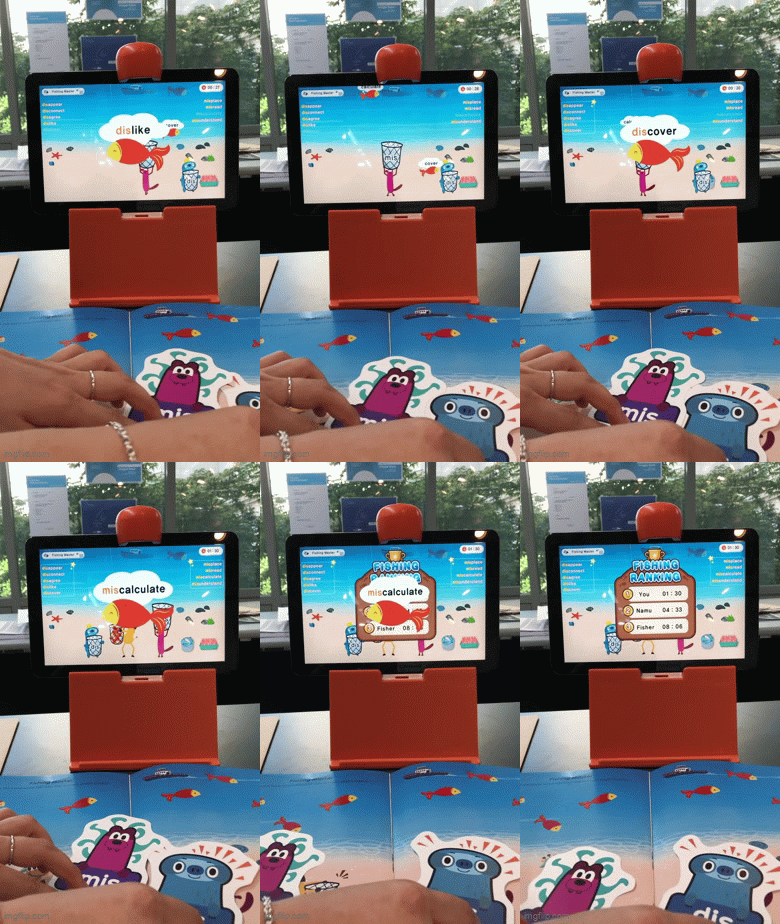
Visual-Spatial Mapping: By using AR "action markers," students could physically manipulate prefixes and root words in 3D space, bridging the gap between symbolic text and semantic meaning.
-
Multimodal Integration: The system was engineered to provide simultaneous visual, auditory, and kinesthetic feedback, ensuring that the "prefix + root" formula was encoded through multiple cognitive channels.
2. Gamification Mechanics & Motivational Metrics
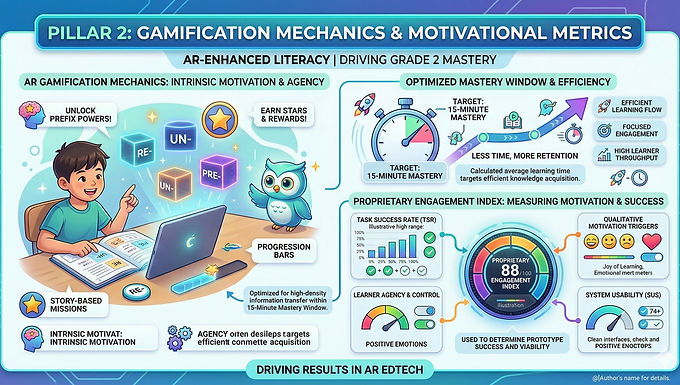
To move beyond passive consumption, I architected a gamification framework centered on learner agency and intrinsic motivation.
-
Efficiency Logic: The learning path was optimized for high-density information transfer, targeting a "15-minute mastery" window per workbook.
-
Proprietary Engagement Index: I developed a multi-dimensional metric to measure engagement and learning outcomes, combining Task Success Rate (TSR) with qualitative motivation triggers to determine prototype viability.
3. Hybrid Research Methodology (Seoul to US)
Managing a global product launch during COVID-19 required a "creativity-under-constraint" approach to UX research.
-
Remote-Synchronous Testing: I spearheaded a hybrid usability test framework where the research team in Seoul moderated real-time sessions with students in Massachusetts via Zoom.

4. Evidence-Based Instructional Design
The project applied core principles of Instructional Technology to ensure the AR features weren't just "novelty," but served a pedagogical purpose.
-
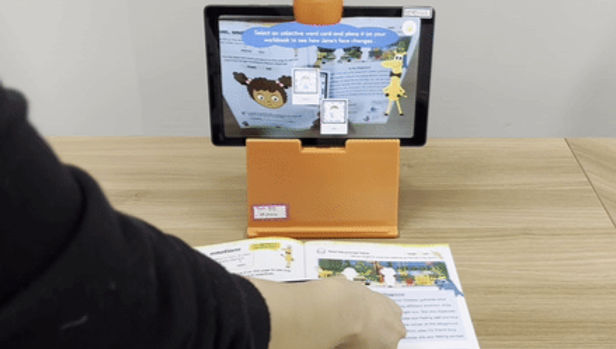
Onboarding Gamification: Based on initial findings of "technical friction," I designed a tutorial mini-game that taught users the technology before the content, significantly improving the System Usability Scale (SUS).
-
Scaffolding & Feedback Loops: Pop-up pedagogical agents were strategically placed to provide "just-in-time" support, ensuring 100% independent product usage.
Impact
-
Directed 0-to-1 Product Strategy: Led the end-to-end conceptualization and global launch of a pioneering AR literacy platform, transforming abstract English prefixes into tangible spatial interactions for Grade 2 learners.
-
Validated Cognitive Efficacy: Achieved a 78% Task Success Rate and an 88 CSAT (Customer Satisfaction) score by embedding Cognitive Load Theory into the foundational architecture, ensuring the AR experience remained pedagogically sound and intuitive.
-
Architected Evaluation Frameworks: Defined success criteria for 35+ spatial prototypes, translating complex learning science into observable metrics that accelerated engineering cycles and ensured product viability.
-
Optimized Learning Efficiency: Reduced average "time-to-mastery" to under 15 minutes per module while increasing System Usability (SUS) to 74+ through a gamified, evidence-based onboarding suite.
-
Engineered Technical Improvements: Spearheaded iterative design cycles that improved marker recognition logic by 40%, significantly reducing technical friction for non-technical users in a classroom setting.